Showing posts with label Hebdige. Show all posts

Monday, October 1, 2012

From The Streets to Runway: A Commodification of the Hip-Hop Style

The Hebdige reading about the construction of commodities of subcultures and analyzing hip-hop as a subculture in class got me thinking about my personal experiences with these. From our list of hip-hop’s system of signs a lot of the fashion items and the over all ‘look’ of the subculture and its normalization today caught my attention. 

Specifically I thought back to this summer when I was working at Macy’s. There was one day that a mother walked in with her son. He looked to be around 5 or 6. The boy had on a flat brim hat and an oversized shirt that said swag in large white letters. I automatically related this to the hip-hop style unconsciously at the time. And the site was unusual to me because I always thought of the commodified hip-hop style to be something adopted at a later age and it being a choice and sometimes phase of the adolescent. I never saw it as something that parents would choose to dress their kids in. 
Reading the Hebdige essay brought me back to this thought and the idea of ‘normalizing’ a sub-culture, hip-hop in this case. I saw that moment now as evidence of the commodification of hip-hop. Parents these days find the hip-hop style as enough of a norm and even a fashion statement that they will dress their kids in it. Twenty years ago and even further back then that this was not the case. 

Hebdige talks about clothing as an example of a commodity and different styles speak to a subculture and/ or its beliefs, rather you actually see yourself as a part of it, “the conventional outfits worn by the average man and woman in the street are chosen within the constraints of finance, ‘taste’, preference... and these choices are undoubtedly significant”. The oversized clothes, the ‘bling’ and the hats and the expensive kicks were symbolic of the hip-hop generation. And just as hip-hop adopted Tommy Hilfiger at one point the fashion industry adopted the urban consumer as a demographic in the 1980‘s. The baggy jeans paired with brand-name jackets, flat brim hats, oversized t-shirts, and ‘bling’ were no longer associated primarily with the Bronx and first generation, they are now worn as an unofficial uniform by the suburban fans. 


Willi Smith was one of the first designers start the look of “streetwear” and as the style was later coined in the fashion industry Cross Colours became a major contributor. This is a Cross Colours ad from the 80’s (thus the loud colors and patterns of the pieces) that was popular in majority of styles from the runway and ready to wear retail styles adopted from runway fashion. 


BET event “Rip the Runway” where Hip-Hop music and fashion are brought together.

These Urban consumer’s brought millions to the fashion industry once they became a target audience. And this stereotypical hip-hop look was adopted and normalized to the point over the years that parents (not all of course) are comfortable enough to dress their children in the style. Something that once represented the rebellion against the upper hand of society, the struggles of living in the Bronx and being a minority has become just another fashion statement today. A few current day designers and brands include Karl Kani, Emily Bustamante, Baby Phat, Sean John, G by Guess, Gucci and FUBU.


Sunday, September 30, 2012

“If the Cap Doesn’t Fit, Wear It”


There is a significant amount of power one has as a bricoleur to criticize, challenge, and instruct mainstream culture. This is because bricoleurs have to be intelligent, cross-cultural, imaginative, and confident; qualities which will enable them to take ownership of their image and commodification and use it to benefit themselves or the groups they represent. Reclaiming suffering and control in society in this way exhibits the power of the bricoleur.


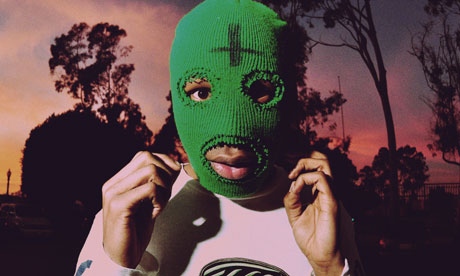
DJ Gangreene’s reference to Odd Future is a great example of the way bricoleurs strategically barge in on positions of fame and power. Gangreene demonstrated how Odd Future uses shock value to garner attention via their premeditated choice of associating with devilry and Nazis. According to Allhiphop.com, two months ago, Odd Future was accused of setting a palm tree on fire on Fairfax Avenue in Los Angeles.


http://allhiphop.com/2012/08/13/hip-hop-rumors-is-odd-future-responsible-for-setting-a-fire-in-cali/

This act was said to reference Odd Future’s song, “Kill People, Burn Sh*t, F*ck School.” A song that begins with “Hey, don't do anything that I say in this song, okay? It's fuckin' fiction
If anything happens, don't fuckin' blame me, white America, fuck Bill O'Reilly.” There is the acknowledgement of the harm that taking the song seriously could cause, and also the sentiment that whatever the outcome is from expressing themselves, it is not Odd Future’s fault because white America’s put them in this position. With lyrics about an absent father, a broke mother, and the messaging, “ Stand for what the f*ck you believe in, and don’t let nobody tell you can’t,” Odd Future seems to have a rather aggressive version of the original message of hip hop, addressing the state of the ‘hood and the frustration at being ignored and put down (rapgenius.com). It seems that the commodities related to Odd Future, such as the eerie, eyeless floating heads on their website and their affinity of “666” seem to build an angry brand, an emotion to which everyone can relate. 666 conventionally symbolizes the Devil, often connotated with Hell. Odd Future has used this historically loaded symbol of hate and (to borrow from Hebdige) juxtaposed it with rap to represent the hell-like conditions of their neighborhoods in LA. By commodifying themselves, the collective has managed to harness the ideation of hate and strike chords with society in a way that rewards them with fame and leadership. They have taken control of their perceived selves and amplified them as if to defiantly say Hey, we’re here. Don’t forget about us because if you do, we will make it a point to regain your attention.

Another example of commodification for the purpose of dignity and power is Nas’s 2008  “Untitled” album, meant to be named, “Nigger.” This racial slur is a loaded pistol pointing a hot bullet at an entire population and has been used perjoratively to deem one as disadvantaged and less than thee. Now why would a black male put himself down in such a way that is so conventionally taboo and harsh? Because as a civil rights bricoleur, identifying and reclaiming the word, he has taken ownership of its subject and approached the issue of racism from a completely different, more confident and controlling manner. Though Nas did succumb to society’s impulses to force him to change the title, he used the commodity perhaps to send the message that yes, he is a nigger and this is how far he’s come. If someone as talented and intellectual as Nas is referred to as a nigger, than call them a nigger because the word will eventually be redefined. Jay-Z commented, "People give strength to words, power to words. If you remove 'nigger,' then you have 'jiggaboo' and 'porch monkey,' the words will keep continuing. How many words you gonna take out? People give the words power. I think we need to direct that [energy] towards the community." (Mtv.com) Nas was directing the energy of the word to society and criticizing it within the "us vs. them" context. 50 Cent accused Nas of strategically going for "shock value," whereas Alicia Keys commented, "If he has something shocking to say, it's because he wants you to pay attention to it." (Mtv.com)


(photo from guardian.co.uk)


Contrary to the idea of words, signs, and symbols in Hebdige's words "exploited as an empty effect," the examples of both Odd Future and Nas show the power and meaning behind reclaiming and controlling commodities to make a statement, as would true bricoleurs.


A concept related to our discussion that I would love input on is this. Does hip hop have to be commodified to be appreciated? To "save" hip hop, do the artists have to create a different and new culture of commodities redefining hip hop or can the existing commodities be brought into greater meaning?

Commodification

I was inspired by George's post on the commodification of hip hop, and it made me think of other ways hip hop has been turned into a commodity. I instantly thought of those certain shows on Nickelodeon or Disney which star a predominantly Black or Hispanic cast. Television is an oppressive institution in itself, because it's primary targeting audience is white people. All of the major shows on television and most popular movies today are comprised of a white cast with the token Black and/or Hispanic person. Let's say you're trying to describe How I Met Your Mother. Would you say "It's about a white group of friends and all of Ted's failed relationships how awesome Barney is?" or would you leave the part about their race out of the description? What if I asked you to describe the cartoon, The Proud Family? You may mention their race, because being Black on television isn't the norm. It is considered "the other."


Hebdige notes that the way to dismantle a subculture is to exploit, commodify it, turn it into something thats family-friendly and not to be feared. The Proud Family is a fine example of that, by taking what's supposed to be perceived as "Black culture" and remodeling it into something appealing for children. 

Here is the intro to The Proud Family. It's sung by Solange Knowles (Beyonce's sister).


Take note how in the beginning of the song, you can hear a record being scratched. Also, 12 seconds in, the entire frame is filled by a shot of fried chicken and waffles that the dad is about to eat. They’re enforcing stereotypes by having this in the intro. Not to mention how it’s being observed every single time someone watches an episode.


Here is a more relevant clip about hip hop from the episode Hip Hop Helicopter. 


It starts out with Big Boy and Shaun Robinson MCing this huge event. The first dancers up on stage are The Chang Triplets, an Asian dance group (I’d just like to point out that their skin color is literally yellow). The entire Black and Hispanic audience looks at these triplets in utter shock as they’re on stage. It’s as if they’re saying this is a Black and Hispanic space, not an Asian space. But eventually the crowd is welcoming after watching their routine. Next, LPDZ performs (LaCienega, Penny, Dijonay and Zoey). They are also not given such a great welcoming until they start dancing and the crowd goes wild. In a way, these dancers could be perceived as b-boys and b-girls. 

Lastly, there are 3 characters on the show named The Gross Sisters. They're supposed to be "thugs". Their skin color is blue because they are often referred to as "ashy," and they like to extort money from their peers and authority figures. The creators of the show took the concept of a gang, and watered it down to the definition of a bully, so it was appropriate for families to watch. What's interesting is how they don't fit into any racial category since blue is not a normal skin color. What is that saying? That they're inhuman, or if they were drawn with brown skin it would perpetuate too many racial stereotypes?


I hope this post made a decent connection about commodifying hip hop because as I wrote it, I couldn't decide if my points were strong enough or if I was just going into a rant about a racist cartoon.


Thursday, September 27, 2012

"Black Nazis Don't Copy"

Someone was bound to bring up Odd Future at some point in this class--I might as well be the first.

For those of you that might not know, Odd Future (Wolf Gang Kill Them All) is a Los Angeles based hip-hop collective. When we speak of hip-hop as a cultural entity/movement rather than merely a music genre, Odd Future is almost that epitome. Transcending just rap, Odd Future boasts members in the skateboarding, photography, dance, and graffiti communities. For more information on their background try their website or ask a white suburban middle schooler.

Since Odd Future has transitioned more into the public eye they have been vehemently ridiculed for some of their members’ lyrical content. Certain members of the group (namely Tyler, The Creator and Earl Sweatshirt—prior to his stint in Samoa) are not shy about their explicit rape, homophobic, and murder references and “Kill People Burn Shit Fuck School” (a younger generation’s “Fuck Tha Police?”) has basically been adopted as the collective’s rallying cry.

Countless responses and blogs have been written analyzing, justifying, and (in every since of the word) demonizing Odd Future’s horrific content, and I my intention is not to continue to beat a horse that has been dead for quite some time. That being said, I feel as if I must bring Odd Future into the conversation regarding Hebdige. Like some in the Punk movement, Odd Future also has been likened to Nazis and devil worshipers (to name a few). This response, though perhaps not unwarranted (apart from rape, Tyler, The Creator’s repertoire includes rhymes claiming Nazi, Swastika, and 666 ties), most of these criticisms have reacted to Odd Future at a purely surface level.

Odd Future has “sampled” the Punk movement in its re-appropriation of faux-Nazi narratives. Lyrics like Tyler, The Creator’s “Seven” (Fuck it, Odd Future some nazis, black nazis don't copy), or Earl Sweatshirt’s “Pigeons” (Double S shit, swastikas on the Letterman, bitch) almost seem like a plagiarism of Sid Vicious’ swastika rebellion. These kids aren’t actually rapists, devil worshipers, or Nazis, they’re teenagers aiming to get a rise out of a generation that they don’t think gets it. It was designed to shock and horrify than as to rally for the neo-Nazi cause:

This represented more than a simple inversion or inflection of the ordinary meanings attached to an object. The signifier (swastika) had been willfully detached from the concept (Nazism) it conventionally signified, and although it had been re-positioned…within an alternative sub-cultural context, its primary value and appeal derived precisely from its lack of meaning: from its potential for deceit (Hebtige 139). 

Though, rather than a socio-political act against British fascism or an oppressive cultural hegemony, the members of Odd Future (mostly 16 through 20 when their Nazi/rape lyrics were in full bloom) did it for its shock value and for the attention (both of which were clearly achieved).


Interestingly enough, as Odd Future has garnered more fame over the past 2 years, their subject matter has gotten a lot tamer. There was virtually no mentions rape or homophobic slurs on their collective’s most recent release and there’s no indication that that subject matter will be returning. Any thoughts to why?

Wednesday, September 26, 2012

Applying Hebdige to Hip hop: Flow, Layer, Rupture

Let's use this space to flesh out how we can use Hebdige and Rose to understand what hip hop means to hip hop heads. What is hip hop's system of signs? And what do they mean?

What are the key signs, symbols and themes in hip hop culture?

What are the homologies in hip hop culture? (E.g) What are the similarities we can identify across hip hop's different elements? What do graffiti, break dancing, rapping and MC'ing share? Do they have similar structures of meaning?

Consider the images below -- How can we use Tricia Rose's concepts of Flow, Layering and Rupture/Breaks to analyze hip hop culture and style?


How does this work in breakdancing?


What are these artists sampling and layering as they construct their hip hop style and image on these album covers? How are they acting as bricoleurs, combining commodities, images and histories to create new meaning?


What are a few core elements of hip hop culture and style? 
Here and in class I want us to brainstorm some of the key signs and homologies of hip hop so we can start to understand what hip hop means to the subcultural members? 


One that stands out to me is a demand to define oneself and one's neighborhood -- to refuse the definitions and representations offered by mainstream press. To demand space and recognition so often denied to young people of color. That seems consistent in hip hop across time and place...

What else? Respond in the comments here or add your own post with the same label.