When I saw this I could not believe my eyes. Fisher price which is a toy company with a main target age of 8 years and younger made a break dancing Mickey. And honestly it is pretty up to par for actual break dancing moves for a kids toy. I think it is somewhat shocking how young kids are starting to be introduced to hip hop. I mean I heard it growing up but I did not fully become immersed in in until about the 7th or 8th grade. So this new target age is something to be curious about and see how it effects the hip hop culture.

Showing posts with label commodification. Show all posts
Showing posts with label commodification. Show all posts
Saturday, December 15, 2012
Hip Hop and Kids
So it seems today that the target age for hip hop continues to get younger and younger and in some ways this could be a sign that it is becoming more a part of our culture and widely accepted which I see as a good thing because it is an art that should be appreciated. The ad below is not the one on TV the other day but since I cannot find the one that has the kids break dancing with mickey in the baggy jeans and flat brim hats this will have to do.

DIY Commodification
My emphasis within the Johnston Center is hip hop culture and the other day, my 2-D Design professor asked us to make a t-shirt with spray paint and stencils. We had to make eight signs using a repeated symbol, so I chose the Men's bathroom figure and made a "How 2 B A Rapper" t-shirt with eight depictions of the sign engaged in stereotypical rapper behavior.

At first, I was psyched about it because I thought it was funny. After showing some people, they asked if I could make them one and I was pleased that they like the shirt. My mind went entrepreneurial for a second and I thought about selling these t-shirts to help finance a summer study abroad. Suddenly, my mind teemed with insights about marketing hip hop that'd I'd learned in REST 235. What kind of message am I sending by outputting something like this? There are no women, there are no redeeming rapper qualities displayed. What would my rapper friends from Watts think if they saw me or some student from our school walking around wearing this t-shirt? It doesn't seem right to make money off of stereotyping rappers. Even though rappers make money off of stereotyping rappers, I've got to take the high road here, right?
What do you all think of this? Is this just a one-time thing to be laughed at and appreciated? Is this the 2 Chainz of t-shirts? Would selling these shirts have a negative effect on society regarding the way rappers are portrayed? I'm interested in hearing what you think. During my moments of uncertainty is when I believe I do my best writing. I wrote this rap song as a response to the t-shirt. Feel free to check it out: www.hannabratton.wordpress.com
Holiday Music, Get on the Ban Wagon
In October most of the music stations
begin to play Holiday music, the 10 top songs that play over and over again on
the radio are sung by a variety of artists no matter what their genre is, they
are singing a new version of Jingle Bells or, My Grandma Got Ran Over By A
Reindeer. I love Christmas and the holiday spirit don’t get me wrong, I just
think it is funny when these artists of hip-hop switch from their type of music
to singing some Christmas carols. Do these artist revamp these songs because it
is what everyone wants to hear at this time of year? Is this to just keep their
image up?
Sunday, December 9, 2012
The Kanye Effect
Ever since Kanye West and Kim Kardashian became "Kimye", Kim Kardashian's style has greatly improved in terms of labels. As seen on her show as well as in the tabloids, Kim has started to wear more brand names and labels which are given to her from Kanye. This shows how in the Hip-Hop culture, some artists are obsessed with commodification and brand names. Kanye is known for his "labeled" attire and ever since he has started to date Kim, she has had the same mindset. I find it interesting that, with dating a Hip-Hop artist, the other subsequently begins to change their style. Here are some photos of Kim and Kanye:


Let me know what you think!
Let me know what you think!
Tuesday, December 4, 2012
Hip Hop Goes Skateboarding
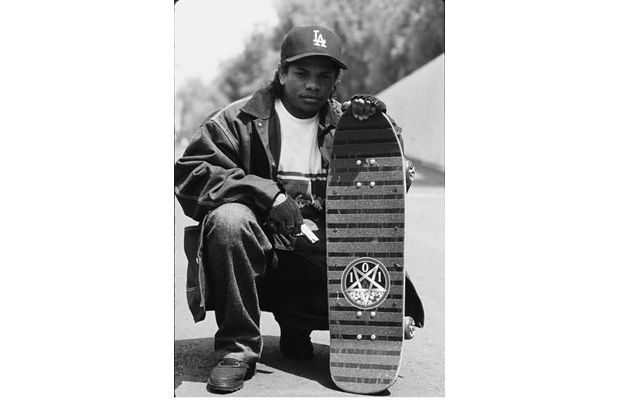
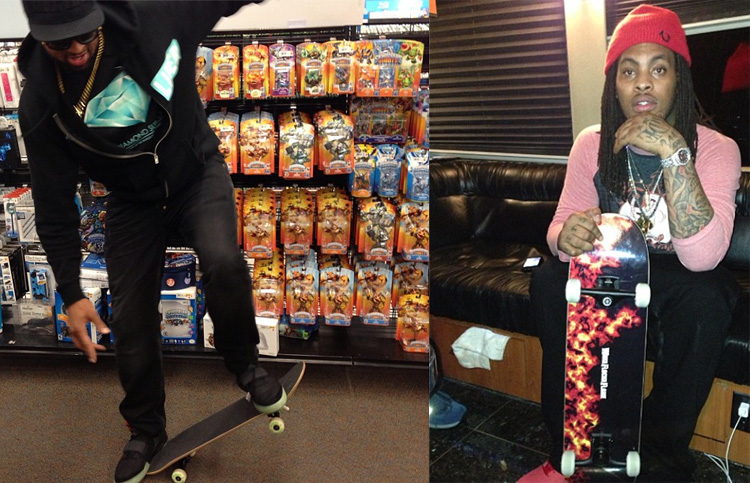
Seeing as how I choose Skate or Die as my DJ title, I thought it would be appropriate to do a post on rappers skateboarding. Skateboarding has taken alot of cues from both punk and hip hop, alike. Skateboard fashion and style has been largely influenced by hip hop because the "truest" form of each exists in the streets. Both hip hop and skateboarding have been commodified from their original street form. This is because the image of both sell, and they sell big. Is rappers skateboarding the ultimate marketing scheme? Or are they 5 years too late?
(Thanks to Complex magazine, for some of the pic finds)
If anyone has pictures or video that I left out please feel free to add it in a response!
Gucci Mane doing a "kickflip"

Eazy-E

Pharrell

French Montana

Yelawolf

Lil Wayne

Soulja Boy


Beastie Boys (MCA was a great snowboarder, too)

Lupe Fiasco

Big Sean

Slim Thug and Waka Flocka Flame
Wednesday, October 31, 2012
Starting Six: On Your Bitch

After reading Imani Perry and Rana Emerson’s pieces on womanhood in hip-hop, I immediately thought back to a music video that was produced by a group of kids I knew in high school: Starting Six. The group is comprised of (you guessed it) six members all two years my senior. Their lyrical content usually revolves around alcohol, sex without a condom on, and general partying. The initial video that I wanted to discuss was one called “Thirsty” (see below), a party song that focuses on the members all trying to get the same woman’s number with the chorus “your bitch is thirstaaay.” Thirsty, as Starting Six uses it, has a dual meaning of 1) thirsty for alcohol and drinks, and 2) a desperation for sex/the men of starting six. I thought I had plenty of material to use, what with the spraying of alcohol on the video girls, specific angle shots of a the main woman in a shower, etc. Though, when I was looking for the video I came across their most recent production, aptly named: SOD (Sit up On a Dick).
To begin, the camera follows
Aliky’s (the female guest star) behind as she walks up to Nic Nac’s house and
knocks on his door. The opening dialogue goes as follows:
Aliky: Nic you invited me over here
there’s nowhere to sit. You have no furniture…
Nic Nac: Yeah, uh, about that. You
could sit on this dick?
Aliky: Ok
The rest of the video, as Nic Nac, Goose, Bread, and Big Steve rap, shows scenes of women in thongs, being covered in alcohol, being shot with toy guns, being violently spanked, sucking and playing with dick-shaped lollipops and dildos, miming use of said dildos; biting of women's underwear, mock humping of sex doll--the list goes on and on...
This video seems to me like the very epitome of the heterosexual male gaze—rivaling Nelly’s “Tip Drill.” The female behind is the largest central focus in the camera’s gaze.

As Imani Perry states: “Even the
manner in which the women dance is a signal of cultural destruction…The women
who appear in [this video] are usualy dancing in a two-dimensional fashion…
more reminiscent of symbols of pornographic male sexual fantasy than of the ritual,
conversation, and sexual traditions of black dance” (137). The women in this
video exist for one purpose only: to act as visual representations of asses of
which the male viewer can imagine to “sit up on his dick.”
What’s interesting about “SOD,”
though, is that most of the women exhibiting these seductive and
two-dimensional dance moves are in fact not
black women. In fact, the “blackest” woman in the video (in strictly terms
of pigmentation), would be Aliky herself, who’s arguably showing the least
amount of skin the 3 minute shoot. Aliky starts off her verse with: “I’m a bad
bitch/ you a bad boy/ got a fat ass/ I’m like your play toy.” Aliky is not only
complicit in the oppressive narrative being constructed, she is one of the main
actors in creating it! “The video is an apt metaphor for her
self-commodification…” and is a explicit form of internalized sexism.
If you're interested in more, here's "Thirsty."
Enjoy....
Tuesday, October 23, 2012
Spectrum of Black Masculinity
Questions:
*Is there a little bit of 50 and a little bit of Barack in every black male?
*How do the limited images of black men affect the development of their identity?
*How does their identity development affect black women?
At one point in the video we watched
today, Byron Hurt was interviewing a group of aspiring rap artists, and asked
them the same question he had been asking throughout the entire film. For the
most part this was his question, "Why do young black rappers insist on
rapping about black on black violence, killing people, selling drugs, and
demeaning other black men as well as women". The answer that the artists
gave was that they portray a violent image coupled with violent lyrics on
purpose, and because that's what record companies want, that is how you get a
deal and that is what is being sold. Essentially, the point being made by both
Byron Hurt and the artists in this section of the film was that you have to be
one dimensional if you want to make it in the rap game. I believe it was said,
"They don't want that conscious rap shit". This is problematic
because rap artists only portray one image of blackness, and the record labels
that sign the artists push that image into society to be consumed by the
masses. Unfortunately for black men, the hip hop/rap image is the only image a
lot of people see, and the only image that a lot of people believe. The
following clip is from a documentary on black masculinity, and addresses black
masculinity by comparing Barack Obama with 50 Cent. Additionally I have posted
all of 50 Cent's album covers from 2003 until now to show how much his image
has changed.
The main points that were made about
50 Cent’s first album cover were that he was portrayed as a hyper masculine black
male, who was invulnerable, and capable of having control in any situation. Additionally
we learned in class about homo eroticism, and how it operates in hip hop. Even
though his second album cover is less realistic than the first one, I would say
his first two album covers are prime examples of it. On both covers you see a
greased up, shirtless black man who is powerful at the same time that he is
exposed. Both of these covers show a 50 Cent that is a tough-guy from the
streets.This is the exact image that record
labels want to sell and the exact image that is consumed by those that listen
to hip hop.
 |
| Get Rich or Die Tryin', 2003 |
 |
| The Massacre, 2005 |
Beginning with The Massacre and ending
with Curtis, you see the biggest shift in the image and identity that 50 Cent
portrays. He is no longer presenting himself as a one
dimensional man and rap artist and he is no longer presenting himself as solely
dangerous and invulnerable. 50 is instead presenting a different side of
himself, toning down his masculinity and being more intentional with the lyrics
he uses in his songs. On this specific album the lyrics of his songs and his
songs in general switch back and forth between a hard street sound that is more
traditional to his career, and a softer deeper sound that he has not expressed
before. This is perhaps caused by the fact that he is more of an established
artist at this point and has become more successful than average rappers.
 |
| Curtis, 2007
Finally there is his most recent album
to date Before I Self Destruct. On this album cover you see a 50 Cent that is
in the process of self destructing and exploding. Perhaps he is referring to
KRS-One and his song Self Destruction, which is an upbeat hip hop song aimed at
stopping violence in poor communities. Or perhaps 50 Cent is feeling the
pressure of maintaining a certain image, and this pressure is causing him to have
identity problems. Either way the image he presents a vulnerable image on this
cover which he did not do with his first two covers.
|
 |
| Before I Self Destruct, 2009 |
Images of black men who have more in common with Obama than they do with 50 Cent are not produced and seen. Street is the only image seen in the media, it is the only image we see of 50 Cent, and for those with no relationships with black people it is the only image they know. There is no mass media produced image that is either the complete opposite of what 50 Cent represents or close to the opposite of his image. The media does not produce images of black men with professional jobs, wearing suits and ties; the CEOs, lawyers, doctors and lawyers are not seen. This is harmful to the black community.
*Is there a little bit of 50 and a little bit of Barack in every black male?
*How do the limited images of black men affect the development of their identity?
*How does their identity development affect black women?
Subscribe to:
Posts (Atom)