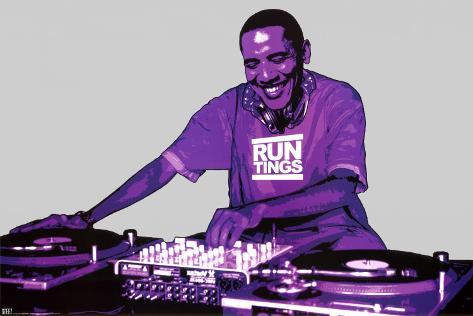
During the 2008 election Obama got the name of being the first "hip hop president". There is much speculation on this because yes he is black and so this can be viewed as a stereotype. But he also received many endorsements from hip hop artists and was included in some songs by people such asNas, Jay-Z, Ludacris, Lil Wayne, Big Boi, Busta Rhymes, Jadakiss, will.i.am, Three 6 Mafia and Young Jeezy. Even in this past election Jay-Z and his wife Beyonce remained huge supporters of him.
It is known however that Obama won the youth vote by a land slide in 2008 and he did so again in this past election. Hip hop is a popular thing in our generation and the target voting group of 18-30 that politicians fight to win the vote of. I believe Obama used this title as "hip hop president" in his favor. He does not support a lot of the meaning and connotations of the lyrics but believes the genre to be an art. Do you think hip hop helped Obama win some of the youth vote? Here are some things I found, both from 2008 and 2012 election times.
The ever famous song after he won
And then I just had to include this one for kicks. It went viral so I am sure many of you have heard this but I figure its pertinent since it is a parody to the song by Eminem "The Real Slim Shady"
Hey class! Another original film here. Like Leo and Fritz, I've also been inspired by the music video. Starring our REST 235's Cameron, George, Leo, Samson, Jordan, Malik, Jared, myself, and a guest appearance by Zac Zilz, this video is our lyrical response to the question, "Where are you from and where are you going?" We recognize the importance of location and place in hip hop and the assumption is that rappers have to come from low socio-economic, marginalized communities to be hip hop artists. Though we all were raised in very different environments, those factors affect, but don't determine what we bring to the hip hop game. Each MCs' interpretation of their physical (and mental) place is very different, but the video takes place in the present, so no matter where we have been or what we have ahead of us, we can take solace in our REST 235 clique.
As I was reading Cheryl Keyes paper on the female black identity in hip hop I was thinking of current day artists that fit into these identities to see if they could be applied. Granted today I think a lot of female rappers cannot fit under just these four identities. The fly girl section is what caught my attention though, as I was reading my mind was screaming Nicki Minaj!!! just about every other sentence.
Nicki Minaj is the current day fly girl. Now as I mentioned in class I love Nicki Minaj. I'm awkwardly obsessed with her and her music. She is one rap artist I can actually rap along with being the white and acutely hip hop knowledgeable person I am (or was before this class!). But lets begin with Keyes definition of a fly girl.
"Fly describes someone in chic clothing and fashionable hairstyles, jewelry, and cosmetics" (coming from blaxploitation films of the 70's era)
Now I am sure there are many people out there who would not call Nicki chic or fashionable because her style is often outrageous to many. But lets look at the Boogie Boys description of a fly girl,
"She sports a lot of gold, wears tight jeans, leather mini skirts, a made-up face, has voluptuous curves, but speaks her mind"
Now if any of you have even seen Nicki Minaj you know that woman has a fat ass. I mean its huge. She has those voluptuous curves all over. And when have you not seen her with a made up face or tight jeans/ pants/ leggings, whatever. On top of this she has the ever-changing hair color and styles that Salt-N-Pepa coined as a part of rap's fly girl.
Style and looks are not the only thing that make up a fly girl. They also work to accept and love their bodies which Nicki does because she ignores all the talk of the media about her behind and just says I am who I am and I love myself. She does not believe there is anything special about her except her talent as a rap artist. On top of this they sculpt their own persona (which Nicki has 4 of) and are independent women. Nicki often talks about this as she fights to be compared to and treated like male rappers because she believes she is on the same level.
On top of all this fly girls like to focus more on their rapping than their dress styles. I believe Nicki does focus on both equally because she does see her style as being a part of who she is, her music and her independence. I mean she would not be the Nicki Minaj we all know with out her style and music. I believe her to be a skilled rapper as she often has playful lyrics and utilizes wordplay well.
This is the opening part from her recent song "The Boys" and I love it. She is saying that she is the Queen when it comes to punch lines but she isn't wearing the shorts and leads into the Boxster which is the cheapest Porsche there is so she is making money. The next line she is basically hating on other female rappers and critics who give her shit, saying don't you have something better to do, and that she can be a boxer (kangaroos known for their 'boxing' matches) if they won't back down and she will fight them, putting them in their place. Now of course rap lyrics can be interpreted in many ways, do you have a different take? This is just an example of a recent song though. Nicki has amazing playful rap in all of her songs and I think she has the right to brag about how strong her rap skills are. Some of her lyrics are hard to understand though so definitely go check it out. Here are a couple other of my favorite songs that I think encompass her as a fly girl through rap skills and style.
Song all about how great of a rapper/ artist she is.
Roman persona
Not a rap, but I love it. Shows her skill as in artist. Marilyn is an idol of hers.
To finish this up I just want to bring up Nicki's personas I mentioned before as a part of being a fly girl. She not only made one persona but four. And they are Nicki, Roman, Martha and Barbie. Nicki is well her, Roman is a gay boy, Martha is Roman's mother and Barbie is the girly some what soft spoken persona. Watch this video to learn a little more. She explains them in her words and the show cuts of different music videos with the different personas and pay attention to the change in voice and style of rap as the personas change, it is really quite an interesting thing and takes some skill.
Interview with Chelsea Lately about her four personas. WATCH!! :)
Ultimately I believe Nicki Minaj to be today's fly girl, what do you think? How do you feel about her as a rap artist?
If you stuck with me through all of this then thank you! I had a lot to say and I have a lot more but I should stop. But if you have any questions or want to talk about anything leave a comment! I will converse with you on this topic, rather related to her as a fly girl or not :)
Given our nearing holiday break, I thought it would be
interesting to see Hip-Hop’s take on both Christmas and Hanukkah.I found Run DMC’s “Christmas Time in Hollis
Queens” (1987) for a Christmas Hip-Hop song. For Hanukkah, it was a bit more difficult to find a song,
however I found Matisyahu’s “Miracle”.
Run DMC: Christmas Time In Hollis Queens
Matisyahu: Miracle
Let me know if you find any other songs! I would be interested to listen to them as well!
Alright, so if you have heard 3oh!3 chances are you noticed their electro, hip hop, pop fusion type sound. Chances are you also noticed there blatantly obvious misogynic references that are apparent in just about every song they release.
So, 3oh!3 is a group consisting of two white men now 27 years and 28 years old respectively. They come from Boulder, Colorado and their name pronounced 303 is sort of creative take on the area code of Denver. After gaining recognition from their self-titled debut effort. Their sophomore record "Want"reached number 44 on the Billboard 200, and the single off of it "Don't Trust Me" reached number seven on the Billboard Hot 100.
Growing up I tended to frequent the thriving heavy metal scene of Denver,and my 13 year old mind vividly remembers when I went to see a collection of metal bands, and 3oh!3 somehow was booked to open. Although it was nowhere near anything I was expecting to see, I found myself oddly fond of the piercing synths, catchy hooks, with ever so shocking brash lyrics.
The band then played the Warped Tour and essentially blew up the Denver radio stations with the line "Don't trust a ho, never trust a ho." Although 3oh!3 is by no means your cut from the cloth hip-hop duo, they do include many themes in their music that directly correlate to those in more traditional hip-hop. These themes include the extreme sexualized objectification of women, the usage of drug and alcohol, living lavish lifestyle, and in a very odd way hyper masculinity.
As 3oh!3 continues to make music, they are in no way falling off the map. They continue to gain more airtime and popularity for their now trademarked white-electro-hip-hop-pop style.
Aside from their catchy pop style, what else do you think lead to the popularity of 3oh!3? Also, would you consider 3oh!3 to be a hip-hop duo? Why or why not?
Here's another tune off their sophomore effort "Want." This song "Rich Man" includes references of liquor, objectification, and even the threat of the frontman locking lips with your sister.
Also, check this interview, where the members of 3oh!3 admit that they believe their controversial lyrics attribute to the popularity in the same way NWA's did.
I found this artist that creates the history of Hip Hop within comics
that begins where we started at the beginning of the semester. I
thought this would be cool to share with the class as a little refresher
as well as a different approach to looking at the story of Hip Hop!
Here is the link to the first comic because it wasn't letting me upload the comic to the blog.
So, I contracted in to make some beats for this class. I thought why not post them on the blog so everyone can see them. Here they are, along with an artists statement.
Becoming
disenchanted with anything is a confusing and unsettling process. I view my
relationship to the art of hip-hop very much as process of disenchantment.
Starting in the realm of unconditional love, I have grown to feel almost
nothing but a mild dislike and discomfort for the genre and culture. I have
given my self a challenge in this course, not only to focus on the culture and
genre that now I feel I have little to nothing to do with, but to create within
that genre. I wanted to make hip-hop make sense to me again, to feel some kind
of connection to the genre I formerly loved so intensely and would have
defended to no end.
The
main reason I had a falling out with rap music was that at a certain point,
after my testosterone surge began to wear down and I was making my way out of
the adolescent years, I found rap hard to relate too, in fact impossible. I
didn’t share the same struggles as my favorite rappers and all though I could
adhere to the most basic of their emotional context I could not agree with the
morals of rap music of the sexism and violence. Even the artists that rap
samples I could not relate entirely too, although I love jazz and funk and
soul, that music is not my parents music and the reworking of those samples is
not my own expression. Black music was not mine to manipulate, I felt too
outside of hip-hop to participate anymore and so I left it all behind.
So,
starting over again. I picked up my old rap production tools: my drum machine,
my sample library. I started from scratch. I didn’t want my beats to sound like
other Madlib or J-dilla or Just Blaze or Pete Rock, I wanted my beats to sound
like me. To do this I had to dig into the music of my past, the music of my
father and my own listening history. I sampled only songs that held some real
location in my history, my fathers favorite song, the song I listened to when
my first girl friend broke up with my after a week (tragically) in sixth grade.
I also only sampled white musicians, music I felt like I had the right to
manipulate and not feel like an outsider doing. But I also wanted my beats to
sound like hip hop, so I incorporated the sounds of hip hop the rhythms of hip
hop the tools of hip hop. The product is one that I feel is entirely my own.
As a multiracial individual, I got really into Keegan-Michael Key and Jordan Peele's sketch comedy show, "Key and Peele" on Comedy Central last year. Their commentary on society's constructions of race, sexual orientation, etc. makes me laugh, as well as think. Two video clips of theirs I found to be relevant to the current class theme of homosexuality and homothuggin' in within gang and hip hop culture.
The first clip is a fantastic articulation of the binary a Black male feels pressured to fulfill as an intelligent, supportive husband while maintaining hood swag:
The clip begins with Key standing on a street corner in Los Angeles, speaking on the phone to his wife with proper annunciation: "Because you're my wife and you love the theater and it's your birthday." Peele walks up and as soon as the eye contact has been made, the switch from loving husband to hood rat occurs. The pronunciation of "theater" changes to "thee-ater" and in a more aggressive tone, Key says, "Ima pick yo ass up at six thirty then," a stark contrast from the gentler expression earlier.
The camera leaves Key and follows Peele as his expression and tone switches from using "c'mon, man" and "aight" with a furrowed brow to an overdramatized "Oh my God, Christian, I almost totally just got mugged right now," in an effeminate, whiney voice characterized as stereotypically gay. This shows how the assumptions made about "the other" within the Black, male community (in this case, that they are hard, hood, unintelligent, unfriendly, demeaning towards women, and masculine) effect how Black males present themselves to each other and perpetuate society's view of how every Black male fits these assumptions.
The second video clip serves to prove the same point:
As Key sets up a drug deal, Peele steps into the scene, grabbing his genitals and embodying masculinity in baggy jeans, a "wife-beater," a backwards hat, and sneakers. The confrontational braggadocio begins and as the banter turns physical, Peele grabs Key's butt. Key exclaims, "Kick it, don't grab it!" in defense of his public sexuality and "hardness." As Peele continues to insinuate homosexual tendencies, Key becomes increasingly furious as his masculinity is being destabilized.
Key declares, "This is wrong, man. This is so wrong," in another attempt to validate his perceived heterosexuality and once Peele challenges him with, "Yeah? What's so wrong about it?" it breaks the barrier of self-consciousness in Key and allows him to accept the fact that he has intimate feelings for Peele, but had thought he was seeing another man.
Again, Key and Peele have managed to clearly display the common perceptions of Black males and throw wrenches into those perceptions so that the public can see through the bravado and fraudulence. It seems that we really are gradually moving towards an era where there is a chance of acceptance of the Black male homosexual within gang and hip hop culture.
I’m really interested in the class’ thoughts on this video. (Try watching in full screen and with headphones).
It seemed to fit
in with our discussion of Austin’s definition of “space.” Videos like this, and
many like it, are on YouTube exhibiting all sorts of Turf styles and
intentionalities (some are to honor a friend who has passed away while others
act in more of an aggressive way: battling other crews in other genres of the
dance).
The second shot, four seconds in, is of a police car as it stops and rounds
the corner in front of the first dancer (No Noize). Whether it was an
intentional cut by the director or not, the presence of the police in the first scene sets a tone for the rest of
the video. Rather than using graffiti, these dancers Turf as a means to
re-claim their space.
Though, I do not want to discredit the initial intention of the dance (a
salute to a fallen friend), I also can’t ignore the theoretical discourse that
is also taking place (perhaps even unconsciously). The dancers have re-appropriated
both public street corners as spaces of their own. East Oakland is a heavily
policed space in Oakland, ruled by “adult distrust of the ‘younger generation’
[often who associate them with gangs], increased surveillance of youth, and the
expansion of economic and social dependency on adults” (Austin 240). Though,
Austin is speaking more to the presence of graffiti in New York City, the same
narrative can be applied here, “Writers made a place for themselves in New York
City by selectively appropriating existing institutions and spaces and
rearticulating these into a new physical and cultural network of their own”
(Austin 245).
Stylistically, though Turf dancing seems almost smoother of a dance than
breaking, one can easily see the parallels between the two. As Tricia Rose
writes:
…these snapping movements take place in one joint
after the previous one—creating a semiliquid effect which moves the energy
toward the fingertip or toe. In fact, two dancers may pass the popping energy
force back and forth between each other via finger-to-finger contact, setting
off a new wave (Rose 81).
One doesn’t need to strain their imagination to see the “sampling” and bricolage Turf
utilizes. Elements of break dance, Soul (think: James Brown), and even ballet can be seen as the
dancers glide in the rain. These elements of the dance were all drawn upon to create something new and relevant to Oakland youth.
Ultimately, apart from a piece of evidence in a
theoretically argument, I see the above video as a work of art. I think it’s
beautiful in more ways than I can seemingly articulate in this blog post. DJ Justice could you perhaps provide additional insight into Turf Dancing's origins and background?
Ever since I was in the third grade I knew I wanted to be an artist. Starting with drawing and broadening into painting, photography, poetry, graphic design and even fashion. I will attempt any art form once but as I have grown they have become more of a hobby then something I actually want to pursue as a profession. I signed up for this class not knowing much about hip-hop; except that it is an art form. I still believe hip-hop is poetry and art, with the beats, lyrics and movement coming together into one master piece. Today however I feel like a lot of main stream hip-hop has created a negative attitude towards the music and culture all together. I’m hoping this class will help re-connect me with the deeper meaning of hip-hop and its roots.
I grew up in Tacoma, WA which was a city known for its ghetto’s. I was first introduced to hip-hop at a young age. I remember G-unit and Nas being all the rage with my friends in elementary school around the fifth grade. I never really felt out of place as my school was racially diverse, but I was the minority there. It wasn’t until middle school that I really got a look at where I lived. My parents moved me into a private school (as much as I fought them), telling me this was for the best as they wanted me to get an education. This was a whole new world to me. My class only had one black student and she was considered an outcast just because she had a different way of expressing herself through music and dance, something I actually understood. Hip-hop culture soon faded from my life all together as I went to a majority white private high school. Main stream hip-hop songs that played on the radio often but not always carrying a derogatory message, became all I knew. My friends I kept in touch with at the public high school made me realize this as they exchanged songs and talked of artists I did not know. The music they played had so much more meaning in the lyrics, it brought me back to the hip-hop I heard when I was younger and the racial diversity and reality of where I lived.
Originally hip-hop was an art to me and I loved the personal messages of life, struggles, death, and even love. Somewhere between middle school and high school though I got sucked into the hype of the main stream songs on the radio and it lost a lot of meaning. I even stopped listening to it for about two year because I got tired of the repeated sex, drugs, and money messages. Hip-hop is poetry and the songs I love the most are those that come with a meaning; on the surface but also deeper in the song. I believe you can’t take this music for face value and I am hoping this class will help me find that understanding again and re-introduce me to the hip-hop music I once loved while teaching me new things about it and even the mainstream hip-hop.
[This is what my friends called me in high school. Well, some still do. But I like it because I float along, go with the flow, and I’ve been told that I have a buoyant spirit about me.]
I’d like to practice all elements of hip hop. DJing because I always have ideas for some great, old songs to sample for new tracks. MCing because according to De La Soul’s “Supa Emcees,” there’s a need for some revival in that department and I enjoy homonyms: “Emcees be needing dough while I make bread like Wonder.” B-Boying because you gotta have the “hop” in hip hop. If I could graffiti, I’d incorporate it into my album cover, potential clothing line, and I’d tag every place I performed.
I remember playing hopscotch and dodging jump ropes in double dutch on hot asphalt in the summer to the tune of Notorious B.I.G.’s “Hypnotize.” In the evenings, my dad would play Blackstreet’s “No Diggity” on the cassette tape and I would rap every word of Queen Pen’s part, despite having no idea what it meant to be “fakin’ jacks” or what Cartier frames were. In the morning before school, before lacrosse games, shower radios, any chance I got, I’d be listening to hip hop.
Nappy Roots, “Good Day” can turn the worst hungover morning into a sprightly start to my day. Jay Z’s “On To the Next One” makes me run faster. People Under the Stairs’ “Acid Raindrops” eases my mind and I’ve cried once while listening to the acoustic version of Tupac’s “Thugz Mansion.” Sometimes it feels as if life is a musical and hip hop is my soundtrack.
Something I appreciate about hip hop is its way of recycling music from many genres, quotations, and history into its form. They say (and by “they,” I definitively mean Wikipedia) that the artist Keith Cowboy coined the term, “hip hop,” in an effort to onomatopoeically taunt a friend who’d just joined the army back in the days when what we now call hip hop was referred to as “disco rap.” Once Keith Cowboy dropped those lyrics while performing, they entered the vast hip hoposphere, a place in which any beat, phrase, or melody is subject to chopping, screwing, and being expanded upon.
This is what I love about hip hop music. I understand and agree with the argument that many rappers lay messages of materialism, power, and self-promotion over their beats. However, if one listens closely even to the most mainstream rap on the radio, woven in between the Benjamins and the Benzes are references to important moments in Black history backed by cherished melodies and harmonies from various genres of music.
I’ve worked in education within lesser privileged communities. The common thread I find, whether it’s in Los Angeles, Philadelphia, even Puerto Viejo, Costa Rica is hip hop. Definitely thousands, but more likely, millions of adolescents’ lives are dictated by hip hop in ways small and large. Jeff Chang mentioned in “Can’t Stop Won’t Stop” that rappers had the attention of his son and if a famous rapper styles his clothes a certain way, a significant part of the world’s population will follow suit. The change I wish to see in the world is rappers coming to understand the power of their influence for progressing and improving lives, especially in poor communities, but potentially in them all.
Note: Thank you to everyone who has sat through Hot Cheetos and Takis at my will.