Given the recent election, I thought it would be good to
look at how politics has affected Hip-Hop.I came across this article from earlier this semester dealing with
masculinity and homosexuality within the Hip-Hop culture.It was written about Obama and how he
endorsed gay marriage earlier this year and in doing so, the support of many
prominent Hip-Hop artists became better known.President Obama’s longtime endorser, Jay-Z, came forward and commended the
President’s actions.Jay-Z compared the
struggle with same-sex marriage with that of the discrimination of African
Americans and stated, "I think it's the right thing to do. It's not about
votes. It's about people. It's the right thing to do as a human being."
The title: “Has Obama made hip-hop rethink masculinity?”
shows there that there is a radical movement accompanying the election and how
many of the modern Hip-Hop artists are speaking up and stepping forward about
their beliefs in order to cause a change in Hip-Hop and society today.I find this empowering coming from the typically
homophobic genre.Recently, through the
presidential election, other Hip-Hop artists have come forth about their
support for same-sex marriage; artists such as Ice Cube and T.I. were among them.Through President Obama advocating same-sex
marriage, Hip-Hop artists have come forth and allowed the public to hear their
beliefs, thus beginning the shift of Hip-Hop’s acceptance of homosexuality.
As a multiracial individual, I got really into Keegan-Michael Key and Jordan Peele's sketch comedy show, "Key and Peele" on Comedy Central last year. Their commentary on society's constructions of race, sexual orientation, etc. makes me laugh, as well as think. Two video clips of theirs I found to be relevant to the current class theme of homosexuality and homothuggin' in within gang and hip hop culture.
The first clip is a fantastic articulation of the binary a Black male feels pressured to fulfill as an intelligent, supportive husband while maintaining hood swag:
The clip begins with Key standing on a street corner in Los Angeles, speaking on the phone to his wife with proper annunciation: "Because you're my wife and you love the theater and it's your birthday." Peele walks up and as soon as the eye contact has been made, the switch from loving husband to hood rat occurs. The pronunciation of "theater" changes to "thee-ater" and in a more aggressive tone, Key says, "Ima pick yo ass up at six thirty then," a stark contrast from the gentler expression earlier.
The camera leaves Key and follows Peele as his expression and tone switches from using "c'mon, man" and "aight" with a furrowed brow to an overdramatized "Oh my God, Christian, I almost totally just got mugged right now," in an effeminate, whiney voice characterized as stereotypically gay. This shows how the assumptions made about "the other" within the Black, male community (in this case, that they are hard, hood, unintelligent, unfriendly, demeaning towards women, and masculine) effect how Black males present themselves to each other and perpetuate society's view of how every Black male fits these assumptions.
The second video clip serves to prove the same point:
As Key sets up a drug deal, Peele steps into the scene, grabbing his genitals and embodying masculinity in baggy jeans, a "wife-beater," a backwards hat, and sneakers. The confrontational braggadocio begins and as the banter turns physical, Peele grabs Key's butt. Key exclaims, "Kick it, don't grab it!" in defense of his public sexuality and "hardness." As Peele continues to insinuate homosexual tendencies, Key becomes increasingly furious as his masculinity is being destabilized.
Key declares, "This is wrong, man. This is so wrong," in another attempt to validate his perceived heterosexuality and once Peele challenges him with, "Yeah? What's so wrong about it?" it breaks the barrier of self-consciousness in Key and allows him to accept the fact that he has intimate feelings for Peele, but had thought he was seeing another man.
Again, Key and Peele have managed to clearly display the common perceptions of Black males and throw wrenches into those perceptions so that the public can see through the bravado and fraudulence. It seems that we really are gradually moving towards an era where there is a chance of acceptance of the Black male homosexual within gang and hip hop culture.
The
term outing arose in the 20th century to describe the uncovering of
people who were “in the closet” or non-heterosexual. In ancient Rome
outing was also used when people violated societies sexual codes and
would result in social stigmas about the persons unmanliness. During the
blacklisting era of McCarthyism government workers that were suspected
of being gay were fired from their jobs and many others left quietly to
avoid being outed weather it was true or not. The government saw them as
perverts and a threat to national security.
Lyrical
outing is when hip hop artist out other MC’s by calling their sexuality
into question. This is not necessarily to prove they are gay but to get
an upper hand on them and to put their realness into question. Having a
secret life of sexual intercourse on the down low would call their
realness into question as would simply feminizing them by calling them
gay. Heterosexuality is a form of realness to many hip hop artists and
claiming that an MC is gay is questioning their realness.
From the reading, Tim'm says, "hip hop heteros rely heavily on the
inappropriate faggot in order to even exist. In a really twisted sort of
way, they rely on the verbal bashing of fags in order to substantiate
their manhood." Basically, in order to assert their masculinity and
heterosexuality, rappers feel the need to bring other rapper’s sexuality
into question, through bashing them with their verses and rhymes.
Jay
Z and Nas have had a history of attempting to out each other. In Nas’s
song “Ether” he calls Jay Z Gay Z and references aspects of Jay Z’s
business to slander his sexuality saying that it’s named after a man
that died of Aids which was and in some cases still looked at as a gay
disease. Jay Z retorted with more gay slurs about Nas’s sexuality
shortly after. However the outing of gay rappers by other MC’s is not
something of the 21st century.
Activist’s
rappers like Easy E and Tupac tried outing Dr. Dre. Calling him gay in
multiple songs. Easy E and Dre have a long history of working together
in NWA where they produced multiple political critiques and
inspirational songs. However when the group split apart there were hard
feelings and the once partners now had a lot of animosity towards each
other. The video below is shows Easy E publicly insulting Dre and
attacking his sexual preference of them were accused at some point for
being gay, Tupac for possibly getting raped in prison and his feminine
childhood, Easy E for contracting the aids virus, and Dr.Dre for a rumor
about him having sexual relations with a young man during his marriage.
One
of the more current outings was that of J Rule and DMX. Rather than
calling J Rule gay DMX tried to use specific stories to legitimize his
claim. As a result J Rule lost nearly all of his fan base and was
completely ousted from the hip hop community and for the most part never
recovered. In the movie that we watched in class artists said that they
insulted each other and spoke poorly of women because all that record
companies wanted to hear were these homophobic battles between MC’s.
This probably made record companies a lot of money and divided the hip
hop community from straight rappers attacking each other to excluding
gay rappers from any contribution to the genre.
“Homo Thuggin’ It”
“Unlike
lyrical outings or gay rapper witch hunts,” homothugs are queer men who
identify with the hyper masculine complex of hip-hop culture. The term
“thug” implies violence and drugs, none of which a homothug must
participate in to gain the title of a thug. A homothug receives his name
just by physically looking like a stereotypical “thug” i.e. wearing
“baggy jeans, doo-rags, throwback basketball jerseys, gaudy jewelry, and
other such indices of hip hop authenticity.” (Hill, 393) The only thing
separating a homothug from a heterosexual hip-hopper is his attraction
to the same sex. By giving a queer rapper or hip-hopper a name to
identify under, this further isolates queerness from hip-hop. It says
that one can’t be part of hip-hop culture and happen to be gay, but if
they’re going to be a queer hip-hopper then they must be a homothug. The
name in itself is a form of “outing,” as if a person’s sexual
preference is the only way they can define themselves. It can be argued
that the term “homothug” is just a nicer way to say “faggot,” although
“faggot” implies effeminate qualities whereas homothug implies masculine
qualities. The term homothug was “coined by antigay former Hot 97 shock
jock DJ Star” as an initial joke, because the term homo and thug were
so contradictory to one another that it was laughable and something to
be mocked. Either way, both terms are rooted from a place of judgment
and disapproval, as a way to group together selective members and
outcast them as the Other.
Homothug
and being on the down-low quickly became synonymous with one another.
Being on the DL meant participating in “any secret activity”, but its
definition warped from being inclusive to implying only homosexual acts
among heterosexual men.
Through the definition of being on the DL, homothugs were further classified into two types of people: the trickster and the psychopath.
Firstly, the trickster uses psychological mind games to lure men and
women into his bedroom. The trickster seems to have bisexual tendencies,
which is viewed as deviant and greedy behavior instead of a personal
sexual preference. Tricksters are viewed as insatiable since they have
sex with more than one gender. Secondly, the psychopath hides under the
guise of a homothug, instead of making a concrete decision about his
sexuality. The psychopath is in denial about oneself, which “ultimately
places his partners in emotional and physical peril.” In reality,
heteronormative society is unable to deal with the concept of sexuality
as being fluid and ever changing. Therefore it creates certain names for
those who choose to not fit in society’s rigid and small box of
possible sexual identities.
Although
this video doesn’t relate to homothugs or gay bashing, it represents a
new era in hip hop. The entire message of the video is pro equality and
gay marriage. It’s a far step from rappers trying to out each other in
rap battles and emasculating one another. Othering Your Own Community Masculinity
in hip hop thrives off the mindset that to be masculine, you must make
other men less than you, which more often than not means comparing them
demeaningly to a woman (bitch, pussy, sissy) or a queer person (faggot,
punk). This system sets straight, black men as the official voice of
hip hop, while simultaneously degrading, dehumanizing, and quite often
perpetuating violence against these more intersectionally oppressed
members of the black community. The
interesting thing about the intense othering of women and queer folk in
hip-hop culture is that it is entirely counterintuitive to any genuine
subculture because it denies the active roles women and queer folk have
occupied and continue to occupy in hip-hop. Black queer people
participate, consume, and contribute to all the aspects of hip-hop
culture, be it DJing, emceeing, graffiti or b-boying. Since
homosexuality has been co-opted and is majorly represented as this white
middle-class lifestyle, it is assumed by straight black men that their
identity as a queer person is intrinsically tied to that lifestyle, not
acknowledging or understanding ways that identities like “queer”,
“black”, and “woman” can all intersect in very complex ways.
Hip hop
culture, while meant as something to give a voice to the oppressed,
still very much works through a hierarchy. Homophobia and sexism are
very prominent in hip hop because homophobia and sexism are very
prominent in society at large. Hip hop does not exist within a bubble,
so while prominent male rappers can have very insightful commentary
about race, most won’t speak up on issues of misogyny or heterosexism.
Tuesday, October 23, 2012
Spectrum of Black Masculinity
At one point in the video we watched
today, Byron Hurt was interviewing a group of aspiring rap artists, and asked
them the same question he had been asking throughout the entire film. For the
most part this was his question, "Why do young black rappers insist on
rapping about black on black violence, killing people, selling drugs, and
demeaning other black men as well as women". The answer that the artists
gave was that they portray a violent image coupled with violent lyrics on
purpose, and because that's what record companies want, that is how you get a
deal and that is what is being sold. Essentially, the point being made by both
Byron Hurt and the artists in this section of the film was that you have to be
one dimensional if you want to make it in the rap game. I believe it was said,
"They don't want that conscious rap shit". This is problematic
because rap artists only portray one image of blackness, and the record labels
that sign the artists push that image into society to be consumed by the
masses. Unfortunately for black men, the hip hop/rap image is the only image a
lot of people see, and the only image that a lot of people believe. The
following clip is from a documentary on black masculinity, and addresses black
masculinity by comparing Barack Obama with 50 Cent. Additionally I have posted
all of 50 Cent's album covers from 2003 until now to show how much his image
has changed.
The main points that were made about
50 Cent’s first album cover were that he was portrayed as a hyper masculine black
male, who was invulnerable, and capable of having control in any situation. Additionally
we learned in class about homo eroticism, and how it operates in hip hop. Even
though his second album cover is less realistic than the first one, I would say
his first two album covers are prime examples of it. On both covers you see a
greased up, shirtless black man who is powerful at the same time that he is
exposed. Both of these covers show a 50 Cent that is a tough-guy from the
streets.This is the exact image that record
labels want to sell and the exact image that is consumed by those that listen
to hip hop.
Get Rich or Die Tryin', 2003
The Massacre, 2005
Beginning with The Massacre and ending
with Curtis, you see the biggest shift in the image and identity that 50 Cent
portrays. He is no longer presenting himself as a one
dimensional man and rap artist and he is no longer presenting himself as solely
dangerous and invulnerable. 50 is instead presenting a different side of
himself, toning down his masculinity and being more intentional with the lyrics
he uses in his songs. On this specific album the lyrics of his songs and his
songs in general switch back and forth between a hard street sound that is more
traditional to his career, and a softer deeper sound that he has not expressed
before. This is perhaps caused by the fact that he is more of an established
artist at this point and has become more successful than average rappers.
Curtis, 2007
Finally there is his most recent album
to date Before I Self Destruct. On this album cover you see a 50 Cent that is
in the process of self destructing and exploding. Perhaps he is referring to
KRS-One and his song Self Destruction, which is an upbeat hip hop song aimed at
stopping violence in poor communities. Or perhaps 50 Cent is feeling the
pressure of maintaining a certain image, and this pressure is causing him to have
identity problems. Either way the image he presents a vulnerable image on this
cover which he did not do with his first two covers.
Before I Self Destruct, 2009
Images of black men who have more in common with Obama than they do with 50 Cent are not produced and seen. Street is the only image seen in the media, it is the only image we see of 50 Cent, and for those with no relationships with black people it is the only image they know. There is no mass media produced image that is either the complete opposite of what 50 Cent represents or close to the opposite of his image. The media does not produce images of black men with professional jobs, wearing suits and ties; the CEOs, lawyers, doctors and lawyers are not seen. This is harmful to the black community.
Questions:
*Is there a little bit of 50 and a little bit of Barack in every black male?
*How do the limited images of black men affect the development of their identity?
*How does their identity development affect black women?
This internet meme has been floating around for a while. It shows two very
different Ice Cubes: one, a gangsta, a real "nigga," who doesn't take
any shit (as expressed through his artillery, posse, and menacing look); and
two, a family movies actor smiling in a goofy life jacket and fishing rod. We
can laugh at the drastic contrast, but what do pictures like this mean for Ice
Cube's identity?
Ice Cube can be whoever he wants to be. But this image kept popping up into
my mind all throughout Chang's "The Real Enemy." For a man once so wrapped
up in “gangstacentricity,” concerned with enemies including “race traitors”
(those not representing their ghetto roots), Koreans, and the oppressive white
majority, he seems to be pretty content with how the system worked out for him.
“Are We There Yet” is a much different movie than “Boyz n the Hood.”
I was just curious on the class’ reaction. I’m not trying to provoke an “Ice
Cube sold out” conversation (unless that’s how you really feel—then go for it),
I just wanted to hear what you all had to say in response.
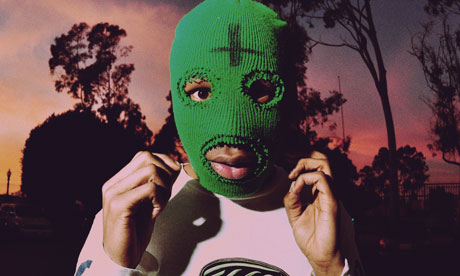
Someone was bound to bring up Odd Future at some point in this class--I
might as well be the first.
For those of you that might not know, Odd Future (Wolf Gang Kill Them All)
is a Los Angeles based hip-hop collective. When we speak of hip-hop as a
cultural entity/movement rather than merely a music genre, Odd Future is almost
that epitome. Transcending just rap, Odd Future boasts members in the skateboarding,
photography, dance, and graffiti communities. For more information on their
background try their website or ask a white suburban middle schooler.
Since Odd Future has transitioned more into the public eye they have been
vehemently ridiculed for some of their members’ lyrical content. Certain
members of the group (namely Tyler, The Creator and Earl Sweatshirt—prior to
his stint in Samoa) are not shy about their explicit rape, homophobic, and murder
references and “Kill People Burn Shit Fuck School” (a younger generation’s “Fuck
Tha Police?”) has basically been adopted as the collective’s rallying cry.
Countless responses and blogs have been written analyzing, justifying, and (in
every since of the word) demonizing Odd Future’s horrific content, and I my intention
is not to continue to beat a horse that has been dead for quite some time. That
being said, I feel as if I must bring Odd Future into the conversation
regarding Hebdige. Like some in the Punk movement, Odd Future also has been
likened to Nazis and devil worshipers (to name a few). This response, though perhaps
not unwarranted (apart from rape, Tyler, The Creator’s repertoire includes rhymes
claiming Nazi, Swastika, and 666 ties), most of these criticisms have reacted
to Odd Future at a purely surface level.
Odd Future has “sampled” the Punk movement in its re-appropriation of faux-Nazi
narratives. Lyrics like Tyler, The Creator’s “Seven” (Fuck it, Odd Future some nazis, black nazis don't copy), or Earl
Sweatshirt’s “Pigeons” (Double S shit,
swastikas on the Letterman, bitch) almost seem like a plagiarism of Sid
Vicious’ swastika rebellion. These kids aren’t actually rapists, devil
worshipers, or Nazis, they’re teenagers aiming to get a rise out of a
generation that they don’t think gets it. It was designed to shock and horrify
than as to rally for the neo-Nazi cause:
This represented more than a simple inversion or
inflection of the ordinary meanings attached to an object. The signifier (swastika)
had been willfully detached from the concept (Nazism) it conventionally
signified, and although it had been re-positioned…within an alternative sub-cultural
context, its primary value and appeal derived precisely from its lack of
meaning: from its potential for deceit (Hebtige 139).
Though, rather than a socio-political act against British fascism or an
oppressive cultural hegemony, the members of Odd Future (mostly 16 through 20
when their Nazi/rape lyrics were in full bloom) did it for its shock value and
for the attention (both of which were clearly achieved).
Interestingly enough, as Odd Future has garnered more fame over the past 2
years, their subject matter has gotten a lot tamer. There was virtually no mentions
rape or homophobic slurs on their collective’s most recent release and there’s
no indication that that subject matter will be returning. Any thoughts to why?