My emphasis within the Johnston Center is hip hop culture and the other day, my 2-D Design professor asked us to make a t-shirt with spray paint and stencils. We had to make eight signs using a repeated symbol, so I chose the Men's bathroom figure and made a "How 2 B A Rapper" t-shirt with eight depictions of the sign engaged in stereotypical rapper behavior.
At first, I was psyched about it because I thought it was funny. After showing some people, they asked if I could make them one and I was pleased that they like the shirt. My mind went entrepreneurial for a second and I thought about selling these t-shirts to help finance a summer study abroad. Suddenly, my mind teemed with insights about marketing hip hop that'd I'd learned in REST 235. What kind of message am I sending by outputting something like this? There are no women, there are no redeeming rapper qualities displayed. What would my rapper friends from Watts think if they saw me or some student from our school walking around wearing this t-shirt? It doesn't seem right to make money off of stereotyping rappers. Even though rappers make money off of stereotyping rappers, I've got to take the high road here, right?
What do you all think of this? Is this just a one-time thing to be laughed at and appreciated? Is this the 2 Chainz of t-shirts? Would selling these shirts have a negative effect on society regarding the way rappers are portrayed? I'm interested in hearing what you think. During my moments of uncertainty is when I believe I do my best writing. I wrote this rap song as a response to the t-shirt. Feel free to check it out: www.hannabratton.wordpress.com
With the Christmas season everyone is out
buying themselves a new pair of Nikes or high tops. It is funny how the trend
always changes but shoes remain the constant item to revamp or keep looking
fresh. When you look at someone you don’t look at their feet so I am wondering
why it is so important to have and own the latest brands of shoes and what it
does to ones image. Another thing I’d like to point out is keeping the tags on
clothing items or more specifically hats to show how “clean” it is. Like many
hip-hop artists, my brother back home does this, he is 13 yrs old and he claims
that in keeping the size tag of his head on the hat that it makes him look
cooler. What is the meaning behind this? Why does it matter what people wear if
they have the talent and drive to do the genre of hip-hop?
What color, what sound? Is it all the
same? Is it real? Who is doing it? Where you doing it? This is all justified by
the definition of Hip Hop. In this song by P-MAC he raises the question of how
one hears color. That is the question I want to ask all of you as well. We have
been talking for weeks about different types of people doing hip hop and what
their sound is or the message they provide or what they don’t provide. I love
this song because I feel that he proclaims that he wasn’t bestowed this talent
he learned it on his own.
“ Allow me to re introduce
myself My name is pmac, no space dash or period Don't mistake it because I'm
tired of it I started off at the bottom of the pyramid Then took my life by the
stering wheel and started steering it Up victory lane boy Yeah I'm untouchable
this ain't gameboy DS Oh I sound black? But how do you hear a color? Think
before you speak you ignorant motherfucker Ain't no one in the music biz tell
me what to do So I learned how to engineer rap and produce By myself Living the
fast life…”
I really enjoyed the video we watched of the turf dancing
in Monday’s class and I began to look up pictures and videos of hip hop dance
because I realized I have not been exposed to much of it.While searching, I happened upon this picture:
I really enjoy this picture and I think it speaks
volumes.Right away I was struck by the
three layers of dance moves and how the eye is drawn to each individually.I like how each level utilizes a different
form of strength with each of them and within this picture, it shows the
diversity of the dance genre.Also, they
are all wearing the same outfit: white pants, sneakers, and no shirt.This allows for the layers to become cohesive
and to allow the eye to go throughout the picture effortlessly.I feel that this picture would not have a
strong presence if it was just one of the dancers; with all three, it places a
sense of communality within the picture as well as within the genre of music and dance.
I hope you enjoy this picture as much as I do.Let me know what else you see.
The Hebdige reading about the construction of commodities of subcultures and analyzing hip-hop as a subculture in class got me thinking about my personal experiences with these. From our list of hip-hop’s system of signs a lot of the fashion items and the over all ‘look’ of the subculture and its normalization today caught my attention.
Specifically I thought back to this summer when I was working at Macy’s. There was one day that a mother walked in with her son. He looked to be around 5 or 6. The boy had on a flat brim hat and an oversized shirt that said swag in large white letters. I automatically related this to the hip-hop style unconsciously at the time. And the site was unusual to me because I always thought of the commodified hip-hop style to be something adopted at a later age and it being a choice and sometimes phase of the adolescent. I never saw it as something that parents would choose to dress their kids in.
Reading the Hebdige essay brought me back to this thought and the idea of ‘normalizing’ a sub-culture, hip-hop in this case. I saw that moment now as evidence of the commodification of hip-hop. Parents these days find the hip-hop style as enough of a norm and even a fashion statement that they will dress their kids in it. Twenty years ago and even further back then that this was not the case.
Hebdige talks about clothing as an example of a commodity and different styles speak to a subculture and/ or its beliefs, rather you actually see yourself as a part of it, “the conventional outfits worn by the average man and woman in the street are chosen within the constraints of finance, ‘taste’, preference... and these choices are undoubtedly significant”. The oversized clothes, the ‘bling’ and the hats and the expensive kicks were symbolic of the hip-hop generation. And just as hip-hop adopted Tommy Hilfiger at one point the fashion industry adopted the urban consumer as a demographic in the 1980‘s. The baggy jeans paired with brand-name jackets, flat brim hats, oversized t-shirts, and ‘bling’ were no longer associated primarily with the Bronx and first generation, they are now worn as an unofficial uniform by the suburban fans.
Willi Smith was one of the first designers start the look of “streetwear” and as the style was later coined in the fashion industry Cross Colours became a major contributor. This is a Cross Colours ad from the 80’s (thus the loud colors and patterns of the pieces) that was popular in majority of styles from the runway and ready to wear retail styles adopted from runway fashion.
BET event “Rip the Runway” where Hip-Hop music and fashion are brought together.
These Urban consumer’s brought millions to the fashion industry once they became a target audience. And this stereotypical hip-hop look was adopted and normalized to the point over the years that parents (not all of course) are comfortable enough to dress their children in the style. Something that once represented the rebellion against the upper hand of society, the struggles of living in the Bronx and being a minority has become just another fashion statement today. A few current day designers and brands include Karl Kani, Emily Bustamante, Baby Phat, Sean John, G by Guess, Gucci and FUBU.
During our most recent class session we discussed aspects and characteristics that defined hip-hop "style." After compiling a list of all of these things that define rappers, djs, breakdancing, graffiti writers, music videos, record covers, and lyrical content. I decided I would look over the list and go through my library of hip hop and try to find concrete examples of many of the things we spoke about and try to break them down and find some sort of purpose for them.
I am going to start with the presence of album skits that seem to be on many hip-hop records. I chose to examine the skits Wu Tang member GZA's "Beneath the Surface" record released in 1999. This record is known to be a very classic representation of east coast hip hop, it includes many vivid memoirs of life growing up in the Park Hill projects in which he was raised. References to drugs, violence, and sex can be seen in many of the songs but because this was GZA's sophomore solo release he touches on many other aspects of life since he has been able to leave the poverty struck project in which he grew up in. Anyways, I found the skits on this record to be very interesting and am going to try to see if I can identify some sort of purpose for their inclusion on the record.
Skit #1-After listening to Skit #1 I immediately thought of the the commodifying of subculture Hebdige discussed in his article. The skit speaks on how connected the world is and that to feel, hear, and understand GZA's experiences in NYC you can be in any place in the world. Hip-Hop is no longer something you have to experience at block parties, or on the corners of low income NYC neighborhoods but has now been commodified commercially and made accessible to anyone throughout the Western world. In 1999 although Hip-Hop was by no means a new development even on record, I still find it interesting he chose to include the technologic advances that allow him to share his message on a global scale.
Skit #2-This skit obviously "samples" from news reports and the mass media in the city. Although, it is clearly satirical and false it shows the hip-hop cultures and GZA's constant feeling of discrimination and over stepping of boundaries in the police department. As we have read over and over in Chang; the hip-hop community and participants in the culture have ongoing "beef"with the police for a myriad of reasons. This skit exemplifies the overwhelming feeling of racism and overly violent actions that existed in the police department responses toward low income minorities at and before the time the record was released. It even says the "random searching" policy in effect was never random and was always focused on minority groups.
Skit #3-Not entirely sure how to interpret this skit. It clearly samples from advertisements that claim they can find people with only a high school transcript a leadership position in a company and I am assuming a relatively large income. However, by the end of the skit it states that they charge an application fee and that no position is ever guaranteed. To me it sounds like a scam, or false advertising. I feel that people of lower socioeconomic status may see this as an escape from their poverty, but then end up losing money and gaining nothing. I would love to hear someone else elaborate or interpret this one differently.
Skit #4-I remember speaking briefly on how children's voices and images seem to be very prevalent in hip-hop and discussing that it may be due to them representing the "future." This skit speaking on gun statistics in the United States that specifically relate to children. It is backed by what begins as a very pleasant, piano line that seems very reminiscent of childhood to me and as the statistics get darker the piano is accompanied by a gloomy section of strings. It end with "Guns are weapons, don't destroy our children's lives"and then a gun shot. I feel as if this was possibly a warning GZA is giving out to future communities to warn against firearms, because from personal experience he saw them devastate people possibly in his neighborhood, surrounding neighborhood etc. Maybe it was a warning he wish his generation received?
So after attempting to somewhat understand these four skits included on "Beneath the Surface" does anyone have any ideas on why he decided to include them, when he could have potentially made similar points through lyrical content in the musical part of the record? Why would these four skits speaking of vastly different subjects be chosen to accompany the album? Is there maybe a common theme all of the skits are tracing on?
Here's a nice track of the record as well. Enjoy.
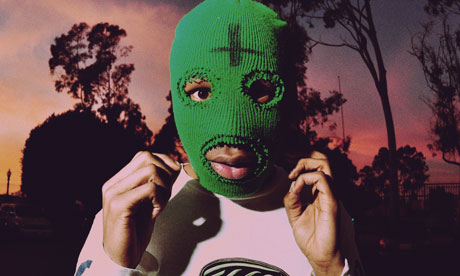
Someone was bound to bring up Odd Future at some point in this class--I
might as well be the first.
For those of you that might not know, Odd Future (Wolf Gang Kill Them All)
is a Los Angeles based hip-hop collective. When we speak of hip-hop as a
cultural entity/movement rather than merely a music genre, Odd Future is almost
that epitome. Transcending just rap, Odd Future boasts members in the skateboarding,
photography, dance, and graffiti communities. For more information on their
background try their website or ask a white suburban middle schooler.
Since Odd Future has transitioned more into the public eye they have been
vehemently ridiculed for some of their members’ lyrical content. Certain
members of the group (namely Tyler, The Creator and Earl Sweatshirt—prior to
his stint in Samoa) are not shy about their explicit rape, homophobic, and murder
references and “Kill People Burn Shit Fuck School” (a younger generation’s “Fuck
Tha Police?”) has basically been adopted as the collective’s rallying cry.
Countless responses and blogs have been written analyzing, justifying, and (in
every since of the word) demonizing Odd Future’s horrific content, and I my intention
is not to continue to beat a horse that has been dead for quite some time. That
being said, I feel as if I must bring Odd Future into the conversation
regarding Hebdige. Like some in the Punk movement, Odd Future also has been
likened to Nazis and devil worshipers (to name a few). This response, though perhaps
not unwarranted (apart from rape, Tyler, The Creator’s repertoire includes rhymes
claiming Nazi, Swastika, and 666 ties), most of these criticisms have reacted
to Odd Future at a purely surface level.
Odd Future has “sampled” the Punk movement in its re-appropriation of faux-Nazi
narratives. Lyrics like Tyler, The Creator’s “Seven” (Fuck it, Odd Future some nazis, black nazis don't copy), or Earl
Sweatshirt’s “Pigeons” (Double S shit,
swastikas on the Letterman, bitch) almost seem like a plagiarism of Sid
Vicious’ swastika rebellion. These kids aren’t actually rapists, devil
worshipers, or Nazis, they’re teenagers aiming to get a rise out of a
generation that they don’t think gets it. It was designed to shock and horrify
than as to rally for the neo-Nazi cause:
This represented more than a simple inversion or
inflection of the ordinary meanings attached to an object. The signifier (swastika)
had been willfully detached from the concept (Nazism) it conventionally
signified, and although it had been re-positioned…within an alternative sub-cultural
context, its primary value and appeal derived precisely from its lack of
meaning: from its potential for deceit (Hebtige 139).
Though, rather than a socio-political act against British fascism or an
oppressive cultural hegemony, the members of Odd Future (mostly 16 through 20
when their Nazi/rape lyrics were in full bloom) did it for its shock value and
for the attention (both of which were clearly achieved).
Interestingly enough, as Odd Future has garnered more fame over the past 2
years, their subject matter has gotten a lot tamer. There was virtually no mentions
rape or homophobic slurs on their collective’s most recent release and there’s
no indication that that subject matter will be returning. Any thoughts to why?