Wednesday, December 5, 2012

Black People and Niggas.

We have heavily discussed the use of the word nigga by black people, but primarily under the framework of hip hop, and gangsta' rap. We have not discussed the relation the word has to historical, or even modern ideas of blackness and the development of black identities. Malik at one point mentioned that "not everyone that is black is a nigga". This statement which is a true, at least to me was never discussed. Although gangsta' rap popularized the use of the word nigga, and used the word as a positive sign and method of communication for those associated with gangsta' rap, not all black people agree with its use or its connotation. Specifically speaking, there are older generation African Americans, and even modern-day African Americans that want to be black, but they do not want to be associated with niggas.
This is a clip from the show The Boondocks. The Boondocks is an American animated series based off of the comic strip created by Aaron McGruder. The show begins with the Freeman family having recently moved from the South Side of Chicago, Illinois to the peaceful and mostly white suburb that is known as Woodcrest. The dynamics Woodcrest provides for much of the comedic moments that take place in the show. Prior to becoming an animated series The Boondocks was already viewed as controversial. This is because the creators of the show and comic strip offer views on issues of race, politics, historical figures, and other issues that are not necessarily widely accepted or popular. The biggest issue that causes the show to create controversy is its casual and frequent use of the word “nigga”. This clip illustrates the black-nigga dynamic that exists between African Americans. Especially older generation African Americans that lived through the Civil Rights Era and are not satisfied with hip-hip and rap whatsoever. 


 In this specific episode the writers of the show rewrite history and tell an alternative story of the “attempted” assassination of Martin Luther King Jr. On April 4, 1968 King is shot and wounded, instead of dying, he falls into a coma in which he remains for 32 years, waking up significantly aged in a hospital bed on October 27, 2000. The episode reaches its climax when King arrives at a church to speak to a crowd of people about forming a new political party, however due to miscommunication and poor advertisement the crowd thinks that they are at the church to party with MLK. King is stunned by the behavior of the crowd and erupts in anger about what he sees. He delivers a speech to the audience lecturing him on his disappointments.

I watch Boondocks all of the time and think that the show is extremely well written and uses humor well to talk about issues that are hard to talk about, or may never be talked about. The show primarily focuses like I said on the Freeman family, and uses the family to talk about real world issues. For example there are episodes about Rkelly, Racial profiling, privilege, gangsta' rap, Snitching, BET-this show covers a wide range of topics. When you watch the video consider everything King says, and the reactions on everyone's faces.

Questions:
*Why is it hard to convince older generation African Americans about the significance and value of hip hop? (True story they hate hip hop, at least modern)
*  What if MLK had never died? How would that have changed history?
*Why is there a divide amongst black people that want to be black but don't want to be niggas. ? Is this somewhat similar to white people that do not want to be associated with poor white trash?

Hip-Hop in Comics


I found this artist that creates the history of Hip Hop within comics that begins where we started at the beginning of the semester.  I thought this would be cool to share with the class as a little refresher as well as a different approach to looking at the story of Hip Hop! 

Here is the link to the first comic because it wasn't letting me upload the comic to the blog.


Here's the first comic.  Enjoy!


Tuesday, December 4, 2012

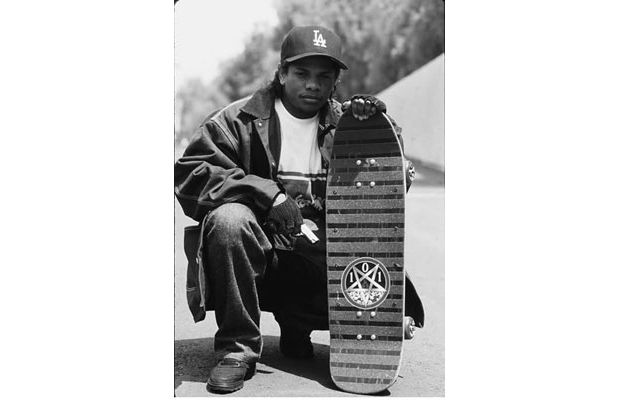
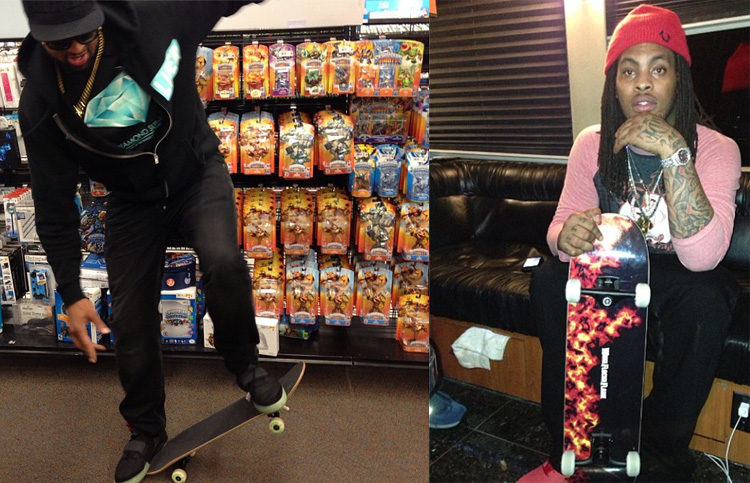
Hip Hop Goes Skateboarding

Seeing as how I choose Skate or Die as my DJ title, I thought it would be appropriate to do a post on rappers skateboarding.  Skateboarding has taken alot of cues from both punk and hip hop, alike.  Skateboard fashion and style has been largely influenced by hip hop because the "truest" form of each exists in the streets.  Both hip hop and skateboarding have been commodified from their original street form.  This is because the image of both sell, and they sell big.  Is rappers skateboarding the ultimate marketing scheme?  Or are they 5 years too late?

(Thanks to Complex magazine, for some of the pic finds)

If anyone has pictures or video that I left out please feel free to add it in a response!


Gucci Mane doing a "kickflip"


Eazy-E

                                                                   Tyler, The Creator


Pharrell


French Montana


Yelawolf


Lil Wayne


Soulja Boy


                                                                    Chris Brown

Beastie Boys (MCA was a great snowboarder, too)

Lupe Fiasco


Big Sean

Slim Thug and Waka Flocka Flame

∆ HIP-HOP ∆ TRI-FOLD ∆

For our event on Saturday, Cameron, Drell, Nyno, and I are working on a tri-fold poster focusing on DJing/MCing. For this we have decided to make a playlist focusing on 10 hip hop songs we regard as some of the most important paired with information on all the artists. We figured since that children will be attending this event, that we should do our best to keep the playlist's profanities to a bare minimun, with out leaving out anything too substantial. Also, the information on the poster will be written in a way we hope will be engaging enough to those of a younger age. The playlist consists of the following:

- (1979) Rapper’s Delight – The Sugarhill Gang
Recognized as the first recorded hip-hop track, Rapper's Delight was the song that popularized hip-hop. The Sugarhill Gang was put together by Sylvia Robinson, a businesswoman who was attempting expose the world outside of New York to the genre. She was successful in doing so in that the song entered the US Top 40. This song greatly differs from the hip-hop we hear today in that it is still very relevant to the disco scene of the 1980s. 

- (1982) The Message – Grandmaster Flash and The Furious Five

Known for their pioneering DJ techniques, The Message was one of the first popular hip-hop songs and a staple in what is now known as "conscious rap." The song tells the story of the struggles and setbacks that come from living in the projects of The Bronx. Through subject matter dealing with drug addiction, violence and racial profiling, The Message exposes listeners to a more serious and thought-provoking side of hip-hop.

- (1982) Planet Rock – Afrika Bambaataa

Bambaataa was one of the most important figures in hip-hop for perfecting the art of DJing. His roots trace back to the birth of hip-hop, the South Bronx in the early 80s. Although emerging from gang culture, Bambaataa has managed to convey his peaceful message to generations of listeners.This song shows his innovations as well as his credibility for combining old school hip-hop with electronic music.


- (1988) Fuck Tha Police –N.W.A.

Perhaps on of the most controversial rap songs ever recorded, Fuck Tha Police was at the forefront of what is now considered "gangsta rap", a grittier style of hip-hop that focuses on the criminal life of rappers coming out of of harsh ghettos. Through lyricism that condones violence towards police officers, N.W.A. were able to express their frustration and contempt against the police force. Though this message may have been gratuitously violent, the impact left by the group would forever change hip-hop by allowing it to be a cultural statement about the extreme ways of dealing with opposing forces.


- (1989) Fight The Power – Public Enemy
Public Enemy have been know for their rebellious attitude projected through their music. In this track, they focus on the power struggle in African American communities. The song feels very confrontational, almost as if it were a public address, supported by lyrics such as "Now that you've realized the pride's arrived / We've got to pump the stuff to make us tough / From the heart / It's a start, a work of art / To revolutionize." The song attempts to spread awareness of racism and prejudice that surround black communities, through using its fast-paced beat and loud, aggressive lyrics. 

- (1989) Shadrach – Beastie Boys
Originating as a punk-rock band, Beastie Boys gained attention for their humorous, yet abrasive take on the genre. The group is acknowledged for their advanced usage of using multiple layers of beats and their diverse range of musical samples, as well as being the first famous white rappers. 

- (1994) Everyday Struggle – The Notorious B.I.G.
Biggie was the central figure in the 90's East Coast rap scene (often considered the Golden Age of Hip-Hop), which resulted in a vicious feud with West Coast rappers of the time, particularly 2Pac. Biggie's lyrics often involved drug dealing and fierce violent imagery, taking a more mafia-style approach to gangsta rap music. The violent life Biggie rapped about would eventually be met with his untimely death in a drive-by shooting in 1997, a murder which is still unsolved.

- (1996) Can't C Me – 2Pac
Emerging from Los Angeles, 2Pac is known for his unique way of combining hardcore gangsta rap with loving, thoughtful lyrics. In certain songs 2Pac promotes violence and and misogyny, where in others he condones sexism and spreads the message of peace. Overall, it is difficult to classify 2Pac as a gangsta rapper or a conscious one. It seems as though his violent messages are what were most impressionable though, as like Biggie, 2Pac was killed in an unsolved drive-by shooting in 1996. 


- (2004) 99 Problems – Jay-Z
Jay-Z is perhaps the most successful rapper of all time. Through his many entrepreneurial involvements, including ownership of The Nets, founder of Rocawear clothing, and friend of Barack Obama, Jay-Z has shown the possible successes that can emerge from rapping.  In 99 Problems, he tells the story of police racial profiling in a way that differs from normal rap lyricism and becomes more of a short story. The song is also noted for its stripped-down beat, which has since become a common trend in many of today's hip-hop songs.

- (2006) Hip Hop Is Dead – Nas

Nas broke ground in 1994 with the release of Illmatic, an album that will forever influence modern hip-hop. In 2006, he released Hip Hop is Dead a hyper-critical song about the current state of hip-hop. 

"Everybody sounds the same, commercialize the game

Reminiscin' when it wasn't all business

It forgot where it started
So we all gather here for the dearly departed"
With this song, it became evident that hip-hop had officially taken a drastic turn, as every genre does. Nas employed  his lyricism as a way to reminisce on the origins of hip-hop and trace its forever-changing history. 


10 Hip Hop Tracks by leodm92 on Grooveshark

Police Brutality, Racism, and Discrimination in NYC


Today a Facebook friend of mine posted this video on the ever so controversial "stop and frisk" policy in NYC.  After our discussion on message rap and on Hip-Hop views of the police, this video seems so relevant. Also, this video give the viewer an interesting insight on racial minorities struggles with the police on the East Coast after we read all of the material on Hip Hop's relationship to law enforcement in Los Angeles. 

This "stop and frisk" policy has been surrounded by controversy since its beginning, and continues to become even more controversial.
At one point in the video an anonymous police officer says that the policy really forces police officers and victims of there searches to feel an "us against them mentality." In order to meet the "quota" (that the NYPD refuses to formally admit exists) officers are forced to racially profile individual against there own personal beliefs. This policy and citizens reaction to it further exemplifies minority group’s distrust and hate for law enforcement officers. It also vividly depicts the very apparent aspect of racism that is said to be very prevalent in NYC.

Take 13 minutes out and watch this video, it's extremely well done and contains a lot of interesting perspectives on racial profiling, police corruption, and other interesting things that are worth examining after our talk on Hip-Hop's relationship with the police. Feel free to post any thoughts, possible solutions, and just anything else this video evoked for you. 


Monday, December 3, 2012

Mouse Trap: Lil Mouse

  Although I am sure everyone is now tired of me riffing about Chicago, I have another feature on the city for you.  This one is my most shocking, yet.  I'm sure it stunned some of you to hear about the things that Chief Keef was up to at the age of 16 and now 17, but this artist is even younger.  For some of you, this will be old news as many internet memes have spawned from what is sure to be the most unbelievable artist to ever emerge from Chicago.
   Hailing from what is known as the "Wild Hundreds", Lil Mouse is a thirteen year old boy who raps about sex, drugs, and violence.  All issues that plague Chicago's South and West side, particularly the neighborhood that Lil Mouse comes from.  His music raises quite a few questions.  First of all, how is someone so young talking about these things? Where are the parents?  Absent, supportive?  Similar to Keef, is his art a product of his environment or is the artist to blame for such a perpetuation of bad themes?
  He has now gone on to have Lil Wayne featured on his hit single "Get Smoked".  I don't want to give to much away about Lil Mouse because the video is very telling, but I think there is discussion to be had about him.  Chicago is receding out of the spotlight and it clearly takes the shock of a 13 year old to bring it's limelight spot back.  Can it really be take any further than this, though?

Saturday, December 1, 2012

connections. beef...eliminated.


There’s this crazy connection between The Game and Notorious B.I.G.

West coast loving east coast. Why was Tupac beefing with Biggie? 


The Game is just as pro-West Side as 'Pac was, but The Game, along with other rappers praise Biggie; especially Dom Kennedy (link this), another rapper committed to showing non-stop love to the West Coast.

That shows that these younger generations are generally more accepting – maybe we’re better at realizing talent!

Oviously not, from the radio.

Seems like we realy are the “Lost Generation” after all. But now to the songs…

The first is a track called: “The Good, The Bad, The Ugly” by The game from his album: “The Red Album.” This just is “Game” telling a  story of a day in his life as gangsta Game. Listen carefully and take notes on the storyline.


That was a great story right? Like a real poem.

Hmmph, where’d he get his inspiration from? Did he just want to tell a story with a good flow?

Look at this album cover? What do you make of it, in relation to this song?

What parts stuck out to you?


Why buy this on iTunes?


Now peep this. It’s called: “Warning” by Biggie Smalls. Take notes. Mental, or whatever notes. ->

Ok, what’d you think? Compare your notes.

…isn’t that crazy?

What specific elements within the songs do you see coming out? Besides Biggie straight KILLIN it!

Game modeled his style, and it was great. The dogs, the guns, the girl, the snitches. The Hip-Hop.

What y’all think? You feel it? 

Moral of the story, things are linking...like gold links. Gold chains!